
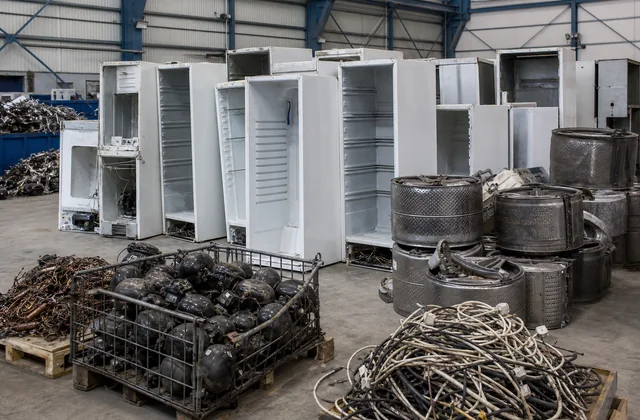
The internal structures of refrigerators, washing machines, small appliances and air conditioners vary widely. Safety disassembly must be completed before mechanical processing, especially components such as batteries, refrigerants, compressors and capacitors, and hazardous disposal cannot be left to the crusher.
Material characteristics
- Electronic waste contains metals, engineering plastics, cables and electronic components. The degree of disassembly determines the incoming material boundary of the crushing section.
- Batteries, live parts, compressors, seals and liquid-containing parts cannot be fed directly as ordinary solid waste.
- The crushing target should serve dissociation and sorting. Too fine particles may increase dust, metal loss and difficulty in sorting.
Key processing challenges
- Live and energy storage components present risks of electric shock and fire.
- Refrigerant, lubricating oil and residual liquid need to be recycled according to regulations.
- Metal, plastic, foam and cables are mixed and require multiple stages of dissociation and sorting.
Equipment-selection criteria
- Establish procedures for disconnecting power, draining fluids, removing batteries, and identifying hazardous parts before discussing mechanical handling equipment.
- Determine primary volume reduction, secondary dissociation, magnetic separation, eddy current or specific gravity separation routes based on the target metal and plastic components.
- Check the tool wear resistance, temperature rise, dust and target component recovery effects through sample testing.
Typical process flow
Home appliances are first registered and classified, the power is turned off and liquids are discharged, and dangerous parts are removed, and then primary crushing, magnetic separation, non-ferrous metal sorting and plastic diversion are carried out. Different household appliances can share some equipment, but the pretreatment stations should be distinguished.
Information required before project evaluation
Complete information helps us define equipment limits, test plans and the full line accurately:
- E-waste categories, sources and dismantling status
- Maximum dimensions, weight and main material composition
- Condition of batteries, liquids, refrigerants and hazardous parts
- Target recycled metal and plastic quality
- Fluctuations in throughput, shifts and incoming materials
- Dust collection, fire protection, electrical and local compliance requirements