
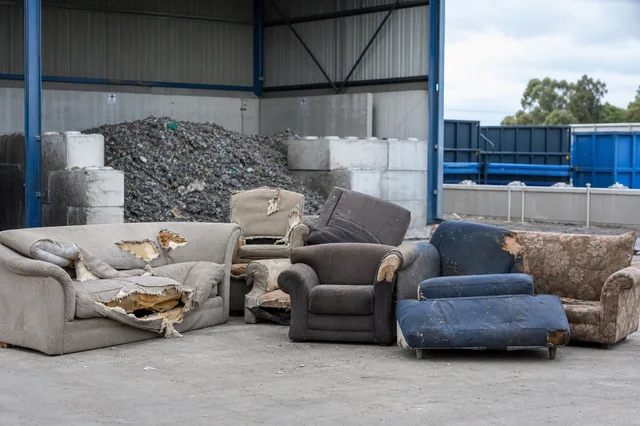
What bulky waste has in common is that it is large in size, but the material is not consistent. A sofa may include a wooden frame, steel springs, foam and fabric, and a mattress may have long steel wires and multiple layers of soft materials. The key to stable processing is to first identify the composition of incoming materials and resource export, rather than just solving "can it be torn apart".
Material characteristics
- The single piece is large in size and irregular in shape, and the density and hardness change rapidly in the same piece of material.
- Fabrics, sponges and springs are prone to entanglement, and nails in wood and furniture hardware can enter the crushing section.
- The sources of collection and transportation vary, and foreign objects such as glass, stones, batteries or sealed containers that are not suitable for direct feeding may be included.
Key processing challenges
- Extra long materials and soft skin may create bridges in the hopper, and the loading and pressing structures of the gripper need to be matched.
- Spring and long fabrics place higher requirements on the knife shaft's anti-winding, cleaning convenience and overload protection.
- If there is no clear separation path for the crushed mixture, it will be difficult to realize the resource value other than volume reduction.
Equipment-selection criteria
- Determine the width of the hopper, feed port and conveyor according to the maximum piece size, grabbing method and site rhythm.
- Prioritize evaluation of low-speed and high-torque shredding, automatic reversal, shaft end sealing and foreign object protection capabilities.
- Configure magnetic separation, screening or air separation according to target components such as wood, ferrous metals, and combustible light substances.
Typical process flow
Typical processes include unloading inspection, pre-sorting of hazardous materials and large foreign matter, gripper loading, low-speed shredding, magnetic separation and manual or mechanical sorting. Subsequent metal, wood or combustible components can be formed according to local acceptance standards; whether to add secondary crushing should be determined by the final particle size and the feed requirements of downstream equipment.
Information required before project evaluation
Complete information helps us define equipment limits, test plans and the full line accurately:
- List and proportion of incoming materials for sofas, mattresses, cabinets, etc.
- Maximum length, width and height, unit weight and daily fluctuations
- Spring, fabric, glass and other foreign objects
- Collection, transportation and feeding methods, peak feeding rhythm
- Target recycled components, final particle size and downstream destination
- Site layout, noise, dust, fire protection and manual sorting conditions