
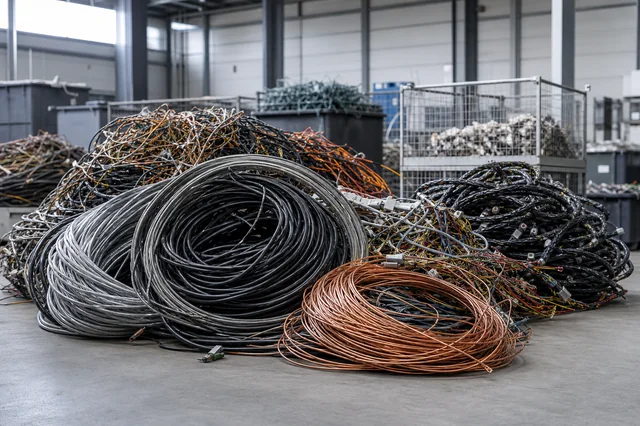
The goal of wire and cable recycling is usually to fully separate the conductor and insulation layer, and then obtain usable components through sorting. Crushing is only a means of dissociation. Particles that are too coarse will result in insufficient separation, while particles that are too fine may increase dust, metal loss and difficulty in sorting. Therefore, the degree of crushing needs to be determined around subsequent sorting.
Material characteristics
- The conductor may be copper or aluminum and the outer layer may consist of PVC, PE, rubber, braid or armored construction.
- Cables have a wide range of diameters, lengths and flexibility, and are easily wound in rolls or long lines.
- Plugs, connectors, armor and other electronic components can change material composition and sorting routes.
Key processing challenges
- Long-term stable feeding and anti-winding are important prerequisites for primary crushing.
- The degree of dissociation of the conductor from the sheath needs to match the working particle size of screening, magnetic separation, airflow or specific gravity separation.
- The fine crushing process may generate plastic dust and heat, and dust collection, temperature rise, and potential contaminants need to be considered.
Equipment-selection criteria
- The primary equipment is responsible for length determination and volume reduction, and the secondary crushing or crushing equipment is responsible for further dissociation. The two sections should not be replaced with the same target.
- Evaluate tool wear resistance, magnetic separation position and foreign object protection based on armored wire ratio, maximum wire diameter and joint condition.
- Determine appropriate screen mesh, air volume or specific gravity parameters through sample testing, and calculate metal recovery rates and plastic cleanliness.
Typical process flow
Common processes are pre-sorting and quantitative feeding, primary shredding, magnetic separation, secondary crushing, screening and air flow or specific gravity separation. The specific sequence depends on whether it contains steel armor, conductor material and finished product requirements; if necessary, dust collection should also be set up to avoid the spread of fine materials at the transfer point.
Information required before project evaluation
Complete information helps us define equipment limits, test plans and the full line accurately:
- Types and proportions of copper cables, aluminum cables, communication wires, armored wires, etc.
- Maximum wire diameter, length, roll status and splice ratio
- Rough composition of conductors, insulation layers and steel accessories
- Target copper and aluminum product purity and plastic destination
- Fluctuations in throughput, work shifts and incoming materials
- Dust collection, power, site and local e-waste compliance requirements