
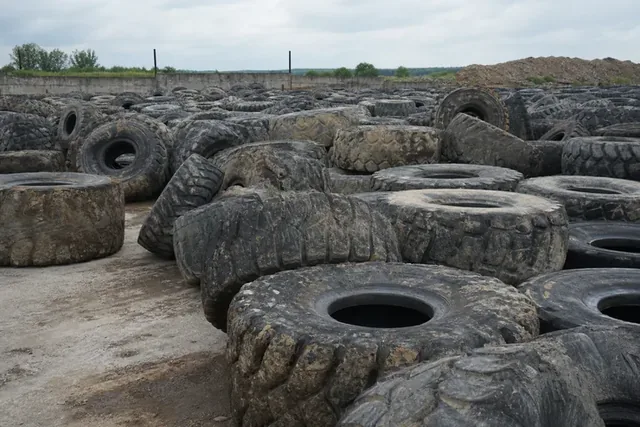
The outer diameter, tire width and single tire weight of engineering tires vary greatly, so it is not practical to directly apply ordinary tire lines. The project must first solve the unloading, storage, hoisting and pre-cutting, and then gradually turn the materials into sizes suitable for subsequent equipment.
Material characteristics
- The outer diameter, tire width, rubber thickness and steel wire structure of car tires, truck and bus tires, agricultural tires and engineering tires vary greatly.
- Rubber has high elasticity and high friction. The beads and cord wires will increase the shear load and affect subsequent separation.
- Coarse broken blocks, rubber blocks without steel wire, rubber granules and rubber powder correspond to different crushing stages and sorting requirements.
Key processing challenges
- A single tire weighs a lot, so handling and positioning it on site are safety aspects in itself.
- Thick rubber and multiple layers of steel wire require higher shear capabilities and stronger structures.
- If the size interfaces of equipment at all levels do not match, it is easy to cause low-efficiency material return.
Equipment-selection criteria
- Use the largest tire allowed by the system as the boundary to determine whether drawing, loop cutting, strip cutting or other pre-processing is required.
- According to the target product, the shredding stages, tool maintenance methods, screening, magnetic separation and fiber separation configurations are deduced.
- Evaluate low-speed torque, overload protection, reversal logic, and continuous feeding capabilities rather than just comparing motor power.
Typical process flow
After the engineering tires are classified and measured, they are segmented using manipulators, cutting machines or special pre-breaking equipment, and then enter heavy-duty shredding and magnetic separation. Whether to continue to produce rubber blocks or rubber pellets in the future should be determined based on local receiving channels and economics.
Information required before project evaluation
Complete information helps us define equipment limits, test plans and the full line accurately:
- Tire types, specifications and proportions of each type
- Maximum outer diameter, tire width, weight and rim condition
- Whether to remove the bead wire and how to load it
- Target rubber block, rubber granules or rubber powder specifications
- Hourly throughput, shifts and raw material fluctuations
- Electricity, site, dust removal, fire protection and storage conditions