
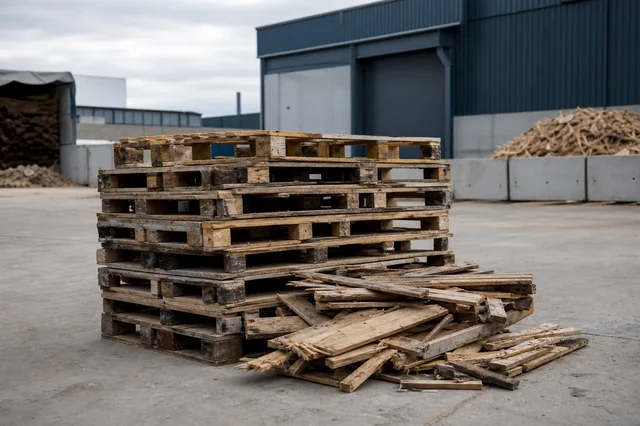
Scrap wood pallets often come with nails, corner jigs and connectors, sometimes mixed with plastic film, labels, gravel or damp wood. The crushing system not only reduces the pallet volume, but also releases and removes metal as stably as possible to protect downstream fine crushing, screening or granulating equipment.
Material characteristics
- Pallets are relatively regular in size but have large gaps and differences in board thickness, wood species and moisture content.
- The distribution of nails and metal connectors is not fixed, and they need to be separated from the wood through magnetic separation after crushing.
- Recycling pallets may contain paint, oil stains, plastics and sediment, and the use of the finished product determines the acceptable range of contamination.
Key processing challenges
- When loading the entire pallet, avoid bridging the hopper and allow the cutter to continuously bite into the beams and boards.
- Metal parts will increase wear, and nails that are not fully released may damage subsequent hammer grinding, granulating or conveying equipment.
- The proportion of fine powder, moisture content and impurities will affect the screening effect and final wood quality.
Equipment-selection criteria
- Determine the inlet and conveyor configuration based on the largest pallet, stacking method, and forklift or gripper loading.
- Choose cutters and low-speed drives that can handle nailed wood, and be clear about the size boundaries that can handle metal parts.
- Determine the secondary crushing, magnetic separation and screen specifications according to the directions of granulation, fuel, plate or size reduction for sale as coarse material.
Typical process flow
Typical processes include incoming material inspection, conveying and loading, primary shredding, suspended magnetic separation and screening. When finer wood chips are needed, secondary crushing can be carried out after magnetic separation, and iron can be removed again at key locations. When the finished product is used for fuel or board, particle size, moisture and contaminants must also be controlled according to the recipient's requirements.
Information required before project evaluation
Complete information helps us define equipment limits, test plans and the full line accurately:
- Types and proportions of pallets and other waste wood
- Maximum size, board thickness, moisture content and stacking method
- Conditions of nails, corners, sand, plastics and coatings
- Target Chip Sizes, Fines Limits and End Uses
- Hourly throughput, shifts and loading methods
- Magnetic separation, dust removal, fire protection, storage and site conditions