
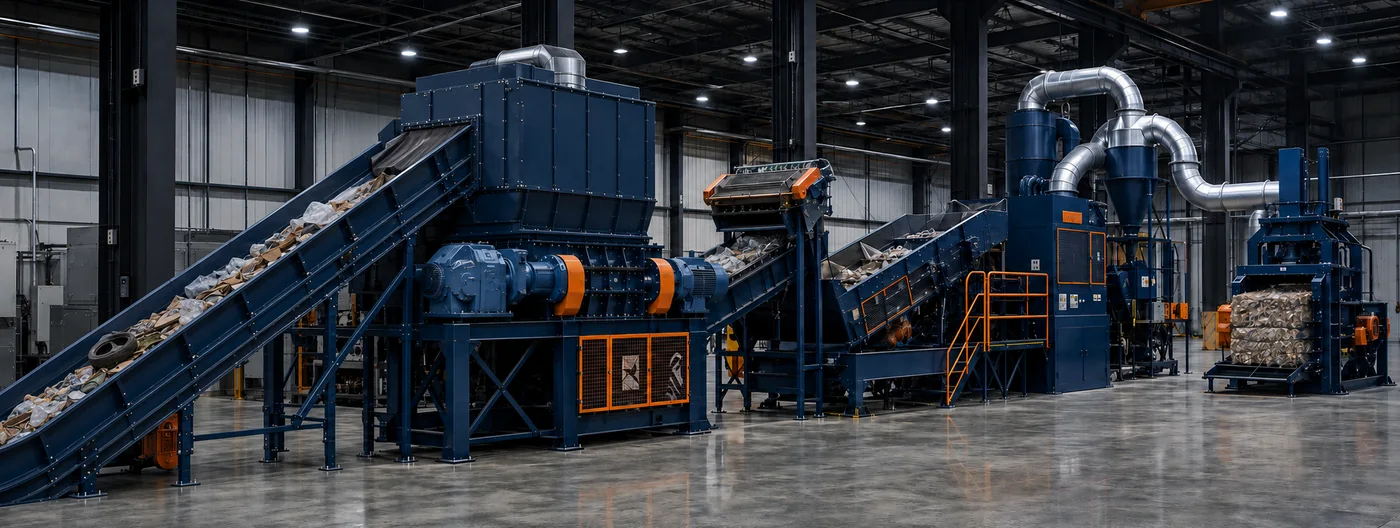
Industrial rubber may come from sheets, seals, conveyor belts or molded offcuts. Formula hardness, thickness and the presence or absence of fiber and steel wire determine completely different shearing and sorting needs.
Material characteristics
- Industrial solid waste changes with production processes and may be mixed with plastics, rubber, fibers, thin metals, fiberglass and adhesives.
- Rolls, strips and sheets are prone to snagging, and thick blocks and metal inserts can create concentrated loads and wear.
- If the discharge material needs to be returned to production or entered into sorting, particle size distribution and contamination control are usually more important than simple volume reduction.
Key processing challenges
- Elastic materials rebound after being compressed and are prone to jumping repeatedly at the feed port.
- Continuous friction builds up heat, which softens and may stick to the tool.
- Wire or fabric reinforcements require additional tool wear and separation routes.
Equipment-selection criteria
- Use a bill of materials and representative samples to define normal batches, extreme batches, and foreign matter that must be removed.
- Select a single-shaft, dual-shaft or secondary crushing combination according to the form and objectives, and check the cutter, screen and drive configuration.
- Incorporate cleaning, tool changing, foreign object removal, and wearing parts replacement times into actual availability assessments.
Typical process flow
Incoming materials are classified as containing steel wire and pure rubber, and thick plates can be cut into sections first. After low-speed shredding, magnetic separation or fiber separation is performed. When uniform particles are required, the equipment enters the equipment with a screen and controls the temperature rise.
Information required before project evaluation
Complete information helps us define equipment limits, test plans and the full line accurately:
- Materials, production sources and proportions of various types
- Maximum size, thickness, form and packing density
- Metal, fiberglass, sand and adhesive conditions
- Normal and peak processing volumes, batch patterns
- Target particle size, fines limits and finished product uses
- Samples, field interfaces and safety information